Buying binoculars usually starts with a number salad — 8x42, 10x50, ED, FMC — and most of it doesn’t matter nearly as much as the marketing suggests. What actually matters is matching a handful of real specifications to what you’re going to do with the binoculars: watch birds in a forest, glass a hillside for elk, scan the horizon from a boat, or follow a football game from the upper deck.
The mistake most first-time buyers make is chasing the highest magnification or the biggest front lenses they can afford. Neither one is automatically better. More magnification means more visible hand-shake and a narrower view; bigger lenses mean more weight on your neck. The right binocular is the one that balances brightness, steadiness, field of view, and comfort for your specific use — not the one with the biggest numbers on the box.
This guide walks through each specification that actually affects what you’ll see and how comfortable you’ll be holding the binoculars, in the order you should think about them when you’re shopping.
Understand the Numbers on Binoculars
Every pair of binoculars is labeled with two numbers, like 8x42 or 10x50. They’re not marketing fluff — they tell you exactly what you’re getting.
- First number (magnification): how many times larger an object appears compared with your naked eye. In 8x42, that’s 8x magnification.
- Second number (objective lens diameter): the width of each front lens, in millimeters. In 8x42, each lens is 42mm across.
Higher magnification isn’t automatically better. It makes distant detail easier to see, but it also exaggerates every twitch of your hands and shrinks your field of view. Bigger objective lenses gather more light, but they add size and weight. Good binoculars are a balance of these trade-offs, not a maximum of either number.
If you’re not sure where to start, 8x42 or 10x42 covers most general outdoor use. You can adjust from there once you know your specific activity. For the full arithmetic behind the numbers, see what the numbers on binoculars mean.
Choose the Right Magnification
Magnification decides how large distant objects look — but also how much your hands show up in the image. The right choice depends on what you’re observing, how far away it is, and how steady you can hold the binoculars.
| Magnification | Best suited for |
|---|---|
| 6x-7x | Wide-field viewing, boating, easy handling |
| 8x | Birdwatching, wildlife, general outdoor use |
| 10x | Distant wildlife, hunting, open landscapes |
| 12x | Detailed observation from a stable position |
| 15x-20x | Long-distance observation, usually with a tripod |
Is 8x or 10x better? These are the two most common choices, and neither wins outright.
8x binoculars tend to show a wider field of view, make it easier to track moving animals, show less visible hand-shake, and stay comfortable for long handheld sessions. 10x binoculars make distant objects look larger and reveal more detail on stationary or far-off subjects, but they amplify hand movement and often have a narrower field of view at a comparable price point.
Choose 8x if you value a wider, steadier handheld view and you’re often tracking moving subjects. Choose 10x if you’re regularly looking at distant, mostly stationary subjects and can hold a steady position. Keep in mind that actual field of view and sharpness vary by model, not just by magnification number.
Objective Lens Diameter
The objective lenses are the large lenses at the front of the binoculars, and their diameter sets how much light can get into the optical system.
| Diameter | Category | Main advantage | Trade-off |
|---|---|---|---|
| 20-25mm | Compact | Lightweight, pocketable | Smaller exit pupil at a given magnification |
| 30-32mm | Mid-size | Good balance of portability and light | Less light than full-size models |
| 40-42mm | Full-size | Versatile, strong all-around performer | Larger and heavier than compacts |
| 50-56mm | Large | Best light-gathering for dawn/dusk | Heavier; benefits from a strap or support |
Larger objective lenses can produce a brighter image, but only up to the point where your own eye’s pupil can actually use the extra light. Lens coatings, prism quality, and overall optical transmission matter just as much as raw lens diameter — a 42mm lens with poor coatings can look dimmer than a well-coated 32mm lens.
A 42mm objective is a sensible default for general outdoor use. Go smaller if you’re prioritizing pack weight; go larger if you’re specifically chasing low-light performance.
Exit Pupil and Image Brightness
Exit pupil is the width of the beam of light leaving the eyepiece and entering your eye. It’s the specification that matters most for dawn, dusk, and nighttime viewing.
The formula is simple: Exit Pupil (mm) = Objective Lens Diameter (mm) divided by Magnification.
Our guide to what the numbers on binoculars mean works this out for every common size. Your own pupils change size with the light — smaller in bright sun, larger in low light. A bigger exit pupil makes it easier to find the full image quickly and can help in dim conditions, but it doesn’t guarantee a brighter picture on its own; lens coatings and glass quality still do a lot of the work.
As a rough guide: 2-3mm suits bright daytime use, 3-4mm covers general daytime viewing, 4-5mm works well for changing outdoor light, and 5-7mm is worth having for dawn, dusk, or astronomy. These are practical starting points, not hard rules.
Field of View
Field of view is how much of the scene you can see at once without moving the binoculars. It’s listed two ways: as an angle in degrees, or as a linear measurement — commonly meters at 1,000 meters, or feet at 1,000 yards. Binoculars rated at 120m/1,000m show a noticeably wider slice of the world than ones rated at 100m/1,000m.
A wider field of view makes it easier to find a moving bird before it flies off, follow wildlife without constantly repositioning, take in a landscape, or track play during a sporting event. Higher magnification usually narrows the field of view, but optical design varies enough between models that it’s worth comparing the published number rather than assuming every 8x binocular beats every 10x one.
Eye Relief
Eye relief is the distance between the eyepiece and the point where you can see the full image. It matters most if you wear glasses: too little eye relief, and you’ll see a cropped image with dark edges because your glasses hold your eyes too far from the lens.
If you wear glasses, REI recommends at least 11mm of eye relief. Twist-up or multi-position eyecups let you fine-tune that distance yourself. If you wear glasses, the only reliable test is trying the binoculars on with them — the number alone doesn’t account for eyecup shape or your own face.
Lens Coatings and ED Glass
Every time light crosses a glass surface, some of it reflects away instead of reaching your eye. Coatings reduce that loss. The terminology is fairly standardized:
| Term | Meaning |
|---|---|
| Coated | At least one surface has a coating |
| Fully coated | All air-to-glass surfaces have at least one coating layer |
| Multi-coated | Multiple layers on at least one surface |
| Fully multi-coated (FMC) | Multiple layers on every air-to-glass surface |
Fully multi-coated optics are generally the better choice, since they cut reflections across the whole light path. But coating terminology alone won’t tell you everything — glass quality, manufacturing precision, and overall construction still matter.
One coating detail worth knowing if you’re considering roof-prism binoculars specifically: look for phase-correction coating. Roof prisms split light in a way that can reduce contrast and resolution unless that light is realigned before it reaches your eye, and phase coating is what does that realignment. It’s a genuine quality marker on roof-prism models, separate from the lens coatings above.
ED glass (Extra-low Dispersion) reduces chromatic aberration — the color fringing you sometimes see around a dark branch against a bright sky. It can meaningfully improve color accuracy and sharpness, but it’s not a guarantee that every ED binocular beats every non-ED one. Judge the whole optical package, not one spec on the box.
Prism Type
Prisms flip the image right-side up so what you see through the binoculars matches what’s actually in front of you. There are two common designs.
Porro prism binoculars have the traditional offset shape, with the objective lenses set wider than the eyepieces. They often deliver good optical performance for the price and can give a stronger sense of depth, but the body is bulkier.
Roof prism binoculars have a straight, streamlined barrel design. They’re more compact, easier to carry on a hike, and simpler to operate one-handed — but they generally cost more to manufacture well, which is part of why phase-correction coating matters on this design.
Choose roof prism if portability and a sleek profile matter most to you. Choose Porro prism if you want a traditional design and strong value for the money. Neither type is categorically better — build quality, glass, and coatings decide the real performance.
Waterproofing and Fog Protection
If you’re using binoculars outdoors, weather resistance matters. Look for:
- Waterproof construction — keeps water out during rain or splashes; check the manufacturer’s actual rating and limits rather than assuming “waterproof” means submersible.
- Nitrogen or argon purging — binoculars filled with dry gas instead of ordinary air resist internal fogging when temperature or humidity swings.
- Rubber armor — improves grip and adds some protection against knocks and scrapes.
- Sealed construction — keeps dust and moisture from getting in through joints and hinges.
Waterproofing is genuinely useful for birdwatching, hunting, hiking, and boating. It matters less for occasional indoor use, like theater or concerts. And one clarification worth making plainly: waterproof binoculars are built to resist rain and splashing, not to be used underwater.
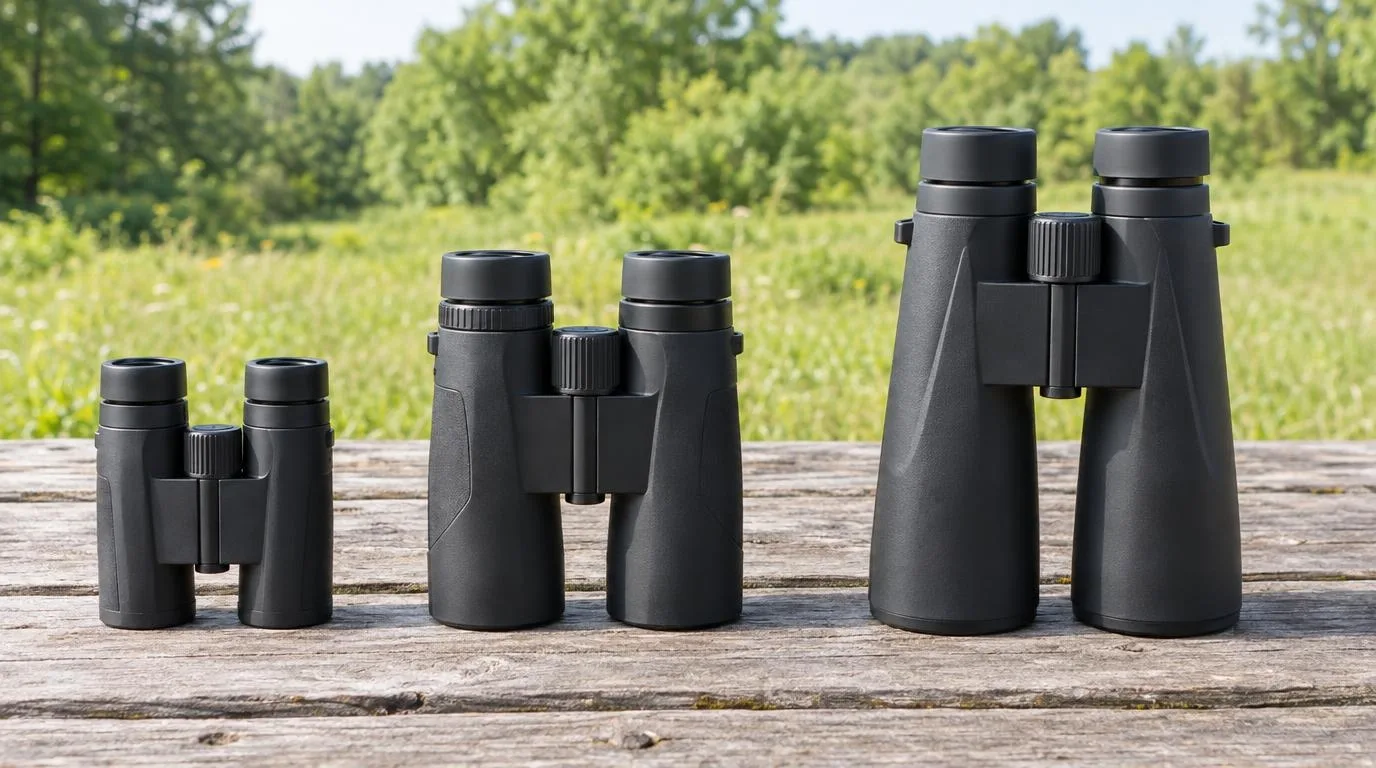
Weight, Size, and Build Quality
The best binoculars aren’t the biggest or most powerful — they’re the ones you’ll actually want to carry and use.
| Category | Common configurations | Main advantage |
|---|---|---|
| Compact | 8x20, 8x25, 10x25 | Easiest to carry |
| Mid-size | 8x30, 8x32, 10x32 | Balance of portability and performance |
| Full-size | 8x42, 10x42 | Versatile outdoor performance |
| Large | 10x50, 12x50, 15x70 | Bigger objectives for specialized, often low-light, use |
Before buying, think through the practical side: How much does it weigh? Can you hold it steady for 15-30 minutes? Does the grip feel secure? Is the focus wheel easy to reach? Does the hinge hold your preferred eye spacing? Does it come with a comfortable strap or harness? If you hike or travel often, a lighter binocular usually beats a heavier one with marginally bigger lenses.
Focusing System and Close Focus
Most general-purpose binoculars use center focus — one wheel adjusts both barrels together, which is convenient when you’re looking at subjects at varying distances. Some marine and specialized binoculars instead use individual focus, where each eyepiece is adjusted separately; this design is common on waterproof marine binoculars because it seals more easily, and it suits viewing subjects at a fairly consistent distance.
Most binoculars also include a diopter adjustment, a separate ring that compensates for any difference in focus between your left and right eye, so both sides end up sharp together.
Close-focus distance is the shortest distance at which the binoculars can focus clearly. A short close-focus distance matters if you’re into butterflies, insects, or flowers as well as distant subjects. If birds and wildlife are your main interest, prioritize a smooth center-focus wheel and a close-focus distance that matches what you actually look at up close.
Choose Binoculars by Activity
The right spec sheet depends heavily on how and where you’ll actually use the binoculars. Treat this as a starting point, not a fixed rule — your eyesight, typical viewing distance, and personal handling preference can shift the ideal choice.
| Activity | Recommended starting point | What to prioritize |
|---|---|---|
| Birdwatching | 8x42 (10x42 for open landscapes) | Wide field of view, comfortable eye relief |
| Wildlife observation | 8x42 general use, 10x42 for more distant detail | Waterproofing, image stability |
| Hunting | 8x42 in wooded terrain, 10x42 or 10x50 for open ground | Low-light performance, weight, weather protection |
| Hiking and travel | 8x25 for lightest packing, 8x32 for a balance | Comfortable handling, low weight |
| Boating and marine use | 7x50, a traditional marine configuration | Steadier handheld view, corrosion resistance |
| Stargazing | 7x50 or 10x50 | Larger exit pupil, a tripod helps with heavier models |
Set a Realistic Budget
You don’t need the most expensive pair to get a genuinely good viewing experience.
When deciding where to spend, prioritize in this order: image sharpness and clarity, quality coatings, comfortable eye relief, a reliable focus mechanism, the right magnification and lens size for your use, waterproofing if you need it outdoors, and manufacturer warranty support. Don’t pay extra for specs you’ll rarely use — a dedicated birder may benefit from premium glass, while a casual traveler is often better served by something lightweight and affordable.
Test Binoculars Before Buying
Two binoculars with identical numbers on the box can feel completely different in your hands, because manufacturing quality and ergonomics vary even within the same specs. If you can, test in person before buying:
- Check that the image looks sharp and clear
- Look for natural color and good contrast
- Check sharpness toward the edges of the view, not just the center
- Make sure the focus wheel turns smoothly
- Confirm the binoculars feel comfortable to hold
- Check the actual field of view
- Test eye relief, especially if you wear glasses
- Check that the eyecups adjust comfortably
- Confirm it focuses at the distances you actually need
- Review the waterproof rating, warranty terms, and included accessories
If possible, try the binoculars at different distances and in both bright and dim light. The most expensive model on the shelf isn’t automatically the right one — comfort and fit for your specific use matter more than price.
Common Mistakes to Avoid
- Chasing the highest magnification. More zoom means more visible hand-shake and a narrower view — match magnification to your actual needs.
- Assuming bigger lenses always mean a brighter image. Coatings, transmission, and exit pupil all affect perceived brightness too.
- Ignoring eye relief. Short eye relief makes binoculars genuinely uncomfortable for glasses wearers.
- Skipping the weight check. A heavy pair gets tiring fast on a long hike or hunt.
- Overlooking field of view. A narrow view makes it harder to find and track moving subjects.
- Assuming ED glass alone guarantees quality. It helps with color fringing, but the whole optical system still determines overall performance.
- Skipping waterproofing for outdoor use. Worth having if you’re regularly out in rain, humidity, or near water.
- Buying on price or brand name alone. Compare actual optical performance, warranty, and ergonomics instead of relying on branding.
Frequently Asked Questions
Are 10x50 binoculars good for low-light conditions?
Yes. A 10x50 binocular has a 5mm exit pupil (50mm objective lens divided by 10x magnification), which is well suited to dawn, dusk, and astronomy. Actual brightness still depends on lens coatings and transmission quality.
What’s the difference between compact and full-size binoculars?
Compact binoculars typically use 20-25mm objective lenses, making them lighter and easier to carry. Full-size binoculars typically use 40-42mm objective lenses, gathering more light at the cost of extra size and weight.
Can I use binoculars while wearing glasses?
Yes. REI recommends 11mm or more of eye relief; look for adjustable eyecups too, and test the binoculars while actually wearing your glasses to confirm you see the full image.
Are expensive binoculars always better?
No. Higher prices often buy better glass, coatings, and construction, but the difference may not matter for every use case. Choose binoculars that match your actual requirements and budget, not just the highest price tag available.
Final Verdict: Which Binoculars Should You Choose?
Start from your activity, not from the biggest numbers on the box. For most people wanting one versatile all-around pair, 8x42 is the easiest starting point. If you regularly watch distant, mostly stationary subjects in open terrain, step up to 10x42. For travel where every ounce counts, a compact 8x25 earns its keep. For dawn, dusk, or stargazing, a 10x50 pulls in more usable light.
Before you buy, compare optical clarity, field of view, exit pupil, eye relief, coatings, weight, focus feel, and weather sealing side by side — not just magnification and price. The right binoculars are the ones you’ll actually enjoy holding up to your eyes, not the ones with the most impressive spec sheet.
Sources
The explanations above draw on the general guidance in the sources below, all read in November 2026. Where a specific figure comes from one source, the text names it.