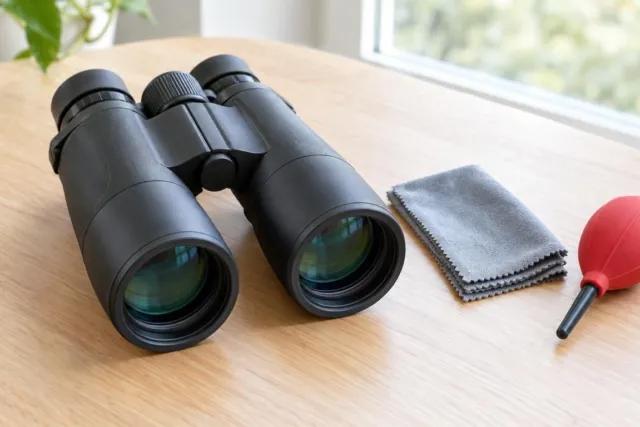
The numbers on binoculars indicate their magnification and objective lens diameter. The first number shows magnification power, meaning how many times larger an object appears compared to the naked eye. For example, 8x means objects appear 8 times larger. The second number represents the diameter of the objective (front) lenses in millimeters. Larger objective lenses collect more light, which can produce brighter images in low-light conditions, but they also make binoculars larger and heavier.
Binoculars use a standard magnification × objective lens diameter (mm) format to describe their specifications. For example, 10x50 binoculars provide 10x magnification with 50 mm objective lenses, while 8x25 binoculars offer 8x magnification with 25 mm objective lenses.
What the numbers do not tell you is which pair is better. A bigger first number is not automatically an improvement, and this guide explains why, with the arithmetic that most buying advice leaves out.
How to read binocular numbers
Using 8x42 as the example:
| Part | Example | What it means |
|---|---|---|
| First number | 8 | Magnification. Objects appear 8 times larger in angular size than to the naked eye |
| The “x” | x | Simply means “times” |
| Second number | 42 | Objective lens diameter: 42 mm |
| Exit pupil (calculated) | 5.25 mm | 42 ÷ 8. The width of the light beam leaving the eyepiece |
Four formulas work on any pair of binoculars:
- Magnification = the first number
- Objective lens diameter = the second number, in millimeters
- Exit pupil = objective diameter ÷ magnification
- Twilight factor = √(magnification × objective diameter)
Every optical figure in this guide is calculated from these formulas rather than copied from a specification sheet, so the numbers are consistent throughout.
What does the first number mean? Magnification
The first number is angular magnification: how much larger an object appears compared with viewing it unaided.
An object 80 meters away, viewed through 8x binoculars, appears roughly as large in angular terms as it would to your naked eye from 10 meters. This is an apparent-size comparison. Nothing physically moves closer, and the binoculars do not improve your eyesight.
Here is how the same object 100 meters away appears at different magnifications:
| Magnification | Object appears as large as if viewed from |
|---|---|
| 7x | 14.3 m |
| 8x | 12.5 m |
| 10x | 10 m |
| 12x | 8.3 m |
| 20x | 5 m |
| 30x | 3.3 m |
What changes as magnification goes up
More magnification is not free. Four things get worse as the first number rises:
- The field of view narrows. For comparable eyepiece designs, true field of view is roughly the apparent field divided by the magnification. If two designs shared a 60° apparent field, 8x would show about 7.5° and 10x about 6°. A narrower view makes it harder to find a bird in a tree or follow a moving animal.
- Hand shake becomes more visible. Your hands move slightly whether you notice it or not. The binoculars magnify that movement along with the image.
- The exit pupil shrinks. At the same objective diameter, more magnification means a narrower beam of light reaching your eye, which can look dimmer in poor light.
- Support starts to matter. Above roughly 10x to 12x, many people find a tripod, a monopod, a rest or image stabilization makes a real difference to comfort.
Higher magnification helps when you need detail at distance and can hold the view steady. It hurts when you need to find fast-moving subjects or view in dim light. This is why experienced birders often choose 8x over 10x, even though 10x sounds better on paper.
What does the second number mean? Objective lens diameter
The second number is the diameter, in millimeters, of each objective lens: the large lens at the front of each barrel, furthest from your eye. It sets how much light the binoculars can collect.
Light collection follows lens area, which grows with the square of the diameter. That makes the differences larger than the numbers suggest:
| Objective | Area compared with a 42 mm lens |
|---|---|
| 25 mm | 35% |
| 32 mm | 58% |
| 42 mm | 100% |
| 50 mm | 142% |
| 56 mm | 178% |
A 50 mm objective collects about 42% more light than a 42 mm objective, not 19% as the diameters alone imply.
The trade-off is bulk. Larger objectives mean a bigger, heavier pair, which matters on a long hike or a full day in the field.
The usual size classes are informal conventions rather than standards:
| Class | Objective size | Typical examples | What it feels like |
|---|---|---|---|
| Compact | 20–28 mm | 8x20, 8x25, 10x25 | Pocketable and light; best in good light |
| Mid-size | 30–35 mm | 8x32, 10x32, 7x35 | Balances portability with a usable exit pupil |
| Full-size | 40–50 mm | 8x42, 10x42, 10x50 | The versatile all-rounders; heavier to carry |
| Large | 56 mm and up | 8x56, 15x70, 25x100 | Low light and astronomy; usually needs support |
A larger objective does not guarantee a brighter image. What reaches your eye depends on the exit pupil, how much light the glass and coatings transmit, and how wide your own pupil opens. That is the next section, and it is the part most guides skip.
The hidden third number: exit pupil
Exit pupil is not printed on binoculars, but it decides more about low-light performance than either number that is.
Exit pupil (mm) = objective lens diameter ÷ magnification
It is the width of the beam of light leaving the eyepiece. Hold a pair at arm’s length in daylight and you will see it: a small bright circle in each eyepiece. That circle is the light the binoculars are handing to your eye.
If the circle is wider than your own pupil, the extra light cannot get in. It is wasted.
| Binocular | Exit pupil |
|---|---|
| 8x42 | 5.25 mm |
| 10x42 | 4.2 mm |
| 10x50 | 5 mm |
| 7x50 | 7.14 mm |
| 8x25 | 3.125 mm |
| 10x25 | 2.5 mm |
Notice that 8x42 and 10x42 share the same lenses but deliver very different beams. The magnification, not the objective, made the difference.
Why your own eye is part of the equation
Your pupil changes size with light. In bright conditions it narrows to roughly 2 to 4 mm. In darkness it opens wider. Sky & Telescope notes that the often-quoted 7 mm maximum is a simplification: some people’s pupils open to nearly 9 mm and others don’t reach 4 mm, with a gradual decline after young adulthood.
This is why 7x50 binoculars, with their 7.14 mm exit pupil, are not automatically brighter in practice. If your eyes open to 5 mm, you are using a 5 mm beam and carrying the weight of 50 mm lenses for light you cannot receive. For many adults, an exit pupil somewhere around 5 mm captures most of the practical benefit.
| Exit pupil | Best suited to |
|---|---|
| Under 3 mm | Bright daylight; limited in dim conditions |
| 3–4 mm | Daytime and bright overcast, such as 8x25 or 10x32 |
| 4–5 mm | A versatile range for general outdoor use and birdwatching |
| 5 mm and above | Useful at dawn, dusk and for astronomy, if your eyes dilate enough to use it |
This is a starting point, not a rule. Optical transmission, coatings, contrast and the conditions you are in all affect what you actually see.
Twilight factor and relative brightness
Two calculated figures appear in binocular specifications and reviews. Both are useful for comparison and neither is a measurement of brightness.
Twilight factor = √(magnification × objective diameter)
For an 8x42: √336 = 18.33. For a 10x42: √420 = 20.49.
Twilight factor attempts to express how much detail you can resolve in dim light, where magnification helps as well as aperture. Celestron, which publishes the formula, notes plainly that it does not take optical quality or coatings into account. A 30x60 scores 42.43, far above any quality 8x42, and would still give you a dim, shaky, narrow view.
Relative brightness = (exit pupil)²
For an 8x42 with a 5.25 mm exit pupil: 27.56. For an 8x32 with a 4 mm exit pupil: 16.
This compares instruments of similar magnification only, and it ignores glass quality and coatings entirely.
Treat both as rough sorting tools. When two binoculars are close on paper, the one with better glass, better coatings and better quality control wins in the field, and no formula will tell you which that is.
What every common binocular size means
Field of view and weight vary considerably between models, so the ranges below are illustrative rather than specifications for any particular pair.
8x42 binoculars
8x magnification, 42 mm objectives. Exit pupil 5.25 mm, twilight factor 18.33.
The most popular all-round size, and for good reason. The 5.25 mm exit pupil is usable at dawn and dusk for most eyes, 8x is steady enough to hand-hold comfortably, and field of view is typically generous at around 6.5° to 8°. Suits birdwatching, wildlife, hiking, safari and general use. If you are buying one pair of binoculars and do not have a specific reason to choose otherwise, this is the size to start from.
10x42 binoculars
10x magnification, 42 mm objectives. Exit pupil 4.2 mm, twilight factor 20.49.
Twenty-five percent more angular magnification than an 8x42 from the same lenses. You see more detail on distant subjects, but field of view is usually narrower, around 5.5° to 6.5°, hand shake is more visible, and the smaller exit pupil gives up some low-light capability. Suits open country, hunting, and anyone glassing distant terrain.
10x50 binoculars
10x magnification, 50 mm objectives. Exit pupil 5 mm, twilight factor 22.36.
This recovers the exit pupil that a 10x42 gives up, at the cost of size and weight. Good for dawn and dusk wildlife viewing and casual stargazing. A harness strap rather than a neck strap makes a long session far more comfortable.
8x32 and 10x32 binoculars
8x32: exit pupil 4 mm, twilight factor 16. 10x32: exit pupil 3.2 mm, twilight factor 17.89.
The middle ground. Noticeably lighter than a 42 mm pair and still capable in good light. An 8x32 is a popular choice for birders who walk a lot. A 10x32 trades low-light capability for reach in a compact body.
7x35 binoculars
7x magnification, 35 mm objectives. Exit pupil 5 mm, twilight factor 15.65.
A classic format. The low magnification is very easy to hold steady and many 7x35 models offer a wide field of view, which makes them forgiving for beginners and good for sports and boating.
8x25 and 10x25 binoculars
8x25: exit pupil 3.125 mm, twilight factor 14.14. 10x25: exit pupil 2.5 mm, twilight factor 15.81.
Pocket-sized, typically 8 to 13 oz. Genuinely useful in good light for travel, hiking, concerts and daytime sports. Both struggle at dusk. Between them, 8x25 is usually the easier pair to live with: larger exit pupil, steadier image.
7x50 binoculars
7x magnification, 50 mm objectives. Exit pupil 7.14 mm, twilight factor 18.71.
The traditional marine and low-light size. The low magnification stays steady on a moving deck and the large exit pupil makes the view easy to hold on target. Heavy, and the full exit pupil is more than many eyes can use.
High-power binoculars: 12x50, 15x70, 20x50, 30x60
| Size | Exit pupil | Twilight factor | Reality check |
|---|---|---|---|
| 12x50 | 4.17 mm | 24.49 | Strong reach; hard to hold still without support |
| 15x70 | 4.67 mm | 32.40 | Classic astronomy binoculars; a tripod is effectively required |
| 20x50 | 2.5 mm | 31.62 | High magnification with a dim, narrow view; needs support |
| 30x60 | 2 mm | 42.43 | Impressive on the box, difficult to use handheld |
A high twilight factor on paper does not produce a bright image. The 30x60 above has the highest twilight factor in this guide and the smallest exit pupil. A big number on the box says nothing about the quality of the glass.
8x42 vs 10x42: which numbers should you choose?
This is the decision most buyers actually face, because both sizes sit side by side in every shop and catalog.
| Feature | 8x42 | 10x42 |
|---|---|---|
| Magnification | 8x | 10x |
| Exit pupil | 5.25 mm | 4.2 mm |
| Twilight factor | 18.33 | 20.49 |
| Relative brightness | 27.56 | 17.64 |
| Field of view | Usually wider | Usually narrower |
| Hand shake | Less visible | More visible |
| Low light | Better exit pupil | Smaller exit pupil |
| Distant detail | Less reach | 25% more reach |
Neither is better in general. Choose 8x42 if you watch birds in woodland, want the steadiest handheld view, are new to binoculars, or often look at dawn and dusk. Choose 10x42 if you glass open country, watch wildlife at long range, or need to pick out detail at distance and can hold a view steady.
If you are genuinely undecided, 8x42 is the safer first pair. A view you can hold still beats a bigger view you cannot.
Binocular sizes compared: the full chart
Exit pupil and twilight factor below are calculated from the formulas in this guide.
| Size | Magnification | Objective (mm) | Exit pupil (mm) | Twilight factor | Class | Typical use |
|---|---|---|---|---|---|---|
| 8x20 | 8x | 20 | 2.5 | 12.65 | Compact | Pocket carry, daylight sightseeing |
| 10x20 | 10x | 20 | 2 | 14.14 | Compact | Bright daylight, light travel |
| 6x21 | 6x | 21 | 3.5 | 11.22 | Compact | Children, very steady views |
| 8x25 | 8x | 25 | 3.125 | 14.14 | Compact | Travel, hiking, concerts |
| 10x25 | 10x | 25 | 2.5 | 15.81 | Compact | Daytime sports, air shows |
| 6x30 | 6x | 30 | 5 | 13.42 | Mid-size | Beginners, very steady views |
| 8x30 | 8x | 30 | 3.75 | 15.49 | Mid-size | Light all-rounder |
| 10x30 | 10x | 30 | 3 | 17.32 | Mid-size | Daytime birding, travel |
| 8x32 | 8x | 32 | 4 | 16.00 | Mid-size | Birding, hiking |
| 10x32 | 10x | 32 | 3.2 | 17.89 | Mid-size | Birding with more reach |
| 7x35 | 7x | 35 | 5 | 15.65 | Mid-size | Beginners, sports, boating |
| 8x42 | 8x | 42 | 5.25 | 18.33 | Full-size | All-round: birding, wildlife, hiking |
| 10x42 | 10x | 42 | 4.2 | 20.49 | Full-size | Open country, hunting |
| 7x50 | 7x | 50 | 7.14 | 18.71 | Full-size | Marine, low light |
| 10x50 | 10x | 50 | 5 | 22.36 | Full-size | Dusk wildlife, casual astronomy |
| 12x50 | 12x | 50 | 4.17 | 24.49 | Full-size | Long range, benefits from support |
| 8x56 | 8x | 56 | 7 | 21.17 | Large | Low light, hunting at dusk |
| 15x70 | 15x | 70 | 4.67 | 32.40 | Large | Astronomy, tripod required |
| 20x50 | 20x | 50 | 2.5 | 31.62 | Large | High magnification, needs support |
| 30x60 | 30x | 60 | 2 | 42.43 | Large | Rarely practical handheld |
What other numbers and letters are on binoculars?
The two main numbers are only the start. These specifications often matter more to your day-to-day experience.
Field of view (FOV). Given in degrees, such as 6.3°, or as a width at distance: feet at 1,000 yards, or meters at 1,000 meters. A wider field makes it easier to find and follow subjects. To convert, multiply degrees by 52.365 for feet at 1,000 yards, or by 17.455 for meters at 1,000 meters. Many manufacturers round these to 52.5 and 17.5, so published figures differ slightly.
Eye relief (mm). How far your eye can sit behind the eyepiece and still see the whole image. If you wear glasses, REI recommends 11 mm or more, and you should check that the full field stays visible with your glasses on. Some manufacturers quote generously, so trying a pair is worth more than the number.
Close focus distance. The nearest point that still focuses sharply, for example 6 ft. Matters for butterflies, insects and flowers; irrelevant if you only look at distant subjects.
Weight. Compacts run roughly 8 to 13 oz; full-size pairs often 20 to 30 oz. This is the specification people underestimate and then regret.
Interpupillary distance (IPD). A range such as 56–74 mm, telling you how far the barrels adjust to match the spacing of your eyes. Worth checking for children and for anyone with narrowly set eyes.
Prism glass: BaK-4 and BK-7. Two glass types used in prisms. BaK-4 can produce a well-illuminated, round exit pupil in suitable designs; BK-7 can also perform well when designed and made properly. Prism glass alone does not determine image quality.
Coatings. “Fully multi-coated” (FMC) generally means multiple anti-reflective layers on all air-to-glass surfaces, which improves light transmission and reduces reflections. Terminology varies between manufacturers, so the label alone does not guarantee a brighter image.
Waterproof ratings. IP ratings follow the IEC 60529 standard and describe performance under specified test conditions.
| Rating | What it means |
|---|---|
| IPX4 | Splash-resistant from any direction. Not tested for immersion |
| IPX7 | Tested for temporary immersion, typically 1 meter for 30 minutes |
| IPX8 | Tested for immersion beyond IPX7; depth and duration set by the manufacturer |
Real-world performance depends on seals, wear and how the binoculars are used, so check the manufacturer’s stated limits rather than trusting the word “waterproof” alone.
Letters in model names. WA means wide angle. WP means waterproof. ED indicates extra-low-dispersion glass, designed to reduce color fringing. HD is a marketing term whose meaning varies by brand, so check the actual specifications rather than assuming it guarantees ED glass.
What do zoom binocular numbers like 10-30x50 mean?
A range such as 10-30x50 means variable magnification from 10x to 30x with 50 mm objectives.
The exit pupil changes as you zoom: 5 mm at 10x, but only about 1.67 mm at 30x. At the top of the range the field of view is usually very narrow, the image looks dim, and hand shake is heavily magnified.
Variable magnification adds optical complexity, and quality varies widely between zoom models. If you are choosing between a zoom and a fixed-power pair at a similar price, the fixed-power pair usually gives a better view, though that is a tendency rather than a rule.
How to choose the right binocular numbers for you
For a full walk-through of choosing a pair, including prisms, coatings and weather sealing, see our guide on how to choose the right binoculars.
Four questions settle it for most people:
- Where will you use them most? Bright, open daylight allows smaller lenses. Woods, dawn and dusk favor a larger exit pupil.
- Can you hold them steady? If you are unsure, stay at 7x or 8x. Steadiness beats magnification.
- How far will you carry them? All-day carrying pushes toward 8x32 or a compact.
- Do you wear glasses? REI recommends 11 mm or more of eye relief; confirm you can see the full field with your glasses on.
| Activity | Good choices | Why |
|---|---|---|
| Birdwatching | 8x42, 8x32, 10x42 | A wide field makes birds easier to find; 8x is steadier for tracking |
| Hunting | 10x42, 10x50, 8x42 | Reach for open country, with a usable exit pupil at dawn and dusk |
| Hiking and travel | 8x25, 8x32 | Light enough that you actually bring them |
| Safari and wildlife | 8x42, 10x42 | Balanced reach, field of view and light gathering |
| Stargazing | 10x50, 15x70 on a tripod | Large objectives collect the light; support matters above 10x |
| Sports and concerts | 7x35, 8x32, 8x25 | A wide, steady view follows fast action |
| Boating | 7x50, 7x35 | Low magnification stays steady on a moving deck |
| Children | 6x21 to 8x25 | Light, forgiving and easy to hold |
Common mistakes to avoid
- Buying the highest magnification you can find. A 20x or 30x image you cannot hold still shows less detail than a steady 8x image.
- Expecting compacts to work at dusk. A 10x25 delivers a 2.5 mm exit pupil. It is a daylight instrument.
- Trusting a big number on a cheap pair. A marking like 30x60 tells you nothing about optical quality, and its 2 mm exit pupil and narrow view make it hard to use handheld.
- Ignoring eye relief when you wear glasses. Short eye relief means you lose the edges of the image, which is more annoying than any specification suggests.
- Comparing twilight factors across very different magnifications. The formula rewards magnification in a way that does not match what you see.
Frequently asked questions
What does the third number on binoculars mean?
Standard binoculars have only two numbers. A third figure in the specifications is usually field of view, in degrees or as a width at 1,000 yards. In a marking like 10-30x50, the three values are minimum magnification, maximum magnification and objective diameter.
What is a good exit pupil for binoculars?
For general daytime use, 3 to 4 mm is usually adequate. For versatile all-round use, 4 to 5 mm works well. For dawn, dusk or astronomy, 5 mm or more helps, provided your eyes dilate enough to use it. Pupil dilation decreases with age and varies between people.
What do 8x25 and 10x25 mean?
Both have 25 mm objectives, making them compact. The 8x25 magnifies eight times with a 3.125 mm exit pupil; the 10x25 magnifies ten times with a 2.5 mm exit pupil. The 8x25 is usually easier to hold steady and performs better in weaker light.
How far can binoculars see?
There is no fixed maximum distance. What you can make out depends on the object’s size and contrast, the air clarity, the optical quality and your eyesight. Magnification makes distant objects appear larger, which helps you resolve detail when conditions allow, but it does not extend a set range.
Final verdict
Read the first number as reach and the second as light-gathering, then divide the second by the first to get the exit pupil, the figure that decides how a pair copes with dim light. For most people, 8x42 is the easiest starting point; step up to 10x for distant subjects in open country, and drop to a compact only if weight matters more than low-light performance. Two pairs with identical numbers can still look very different, because glass, coatings and build quality are not in the numbers at all.
Sources
The formulas and figures above draw on the sources below, read in November 2026. Exit pupil, twilight factor, relative brightness, light-gathering area and field-of-view conversions are our own calculations from those formulas.